
Arizona MVD Permit Practice Test 1
Test 1 of 10. Pick an answer for each question to see if it is right and why; your score appears at the end. You need 24 correct answers to pass, the same ratio as the real Arizona test.
- Questions30
- Correct to pass24
- Passing score80%
- Minimum age15 years 6 months
-
1. Do the Arizona minimum liability amounts differ between an owner policy and an operator policy?
Show answer
Answer B: No, the same minimum amounts apply to both kinds of policy
The Arizona statute sets a single set of minimum amounts and applies them to owner policies and operator policies alike.
-
2. What must an Arizona emergency vehicle be doing before other drivers owe it the statutory duty to yield?
Show answer
Answer C: It must display red or red and blue lights visible from 500 feet and sound an audible siren
The Arizona duty to yield attaches when the authorized emergency vehicle shows red, or red and blue, lights visible from a distance of 500 feet and sounds an audible siren.
-
3. What jail term does Arizona require for a second DUI conviction committed within 84 months of the first?
Show answer
Answer D: 90 days in jail, of which 30 days must be served consecutively
A second Arizona DUI within 84 months carries at least 90 days in jail with 30 of them served consecutively, a minimum 500 dollar fine, a one year revocation and 30 hours of community service.
-
4. What offense does an Arizona driver commit by refusing to show a license after a peace officer has signaled the vehicle to stop?
Show answer
Answer A: A class 2 misdemeanor
Arizona makes both failing to stop for a peace officer and refusing to exhibit the driver license class 2 misdemeanors.
-
5. A train has just passed a crossing that carries more than one set of tracks. What should you do?
Show answer
Answer B: Wait until the warning devices stop and you can see clearly along every track
A passing train can hide a second one coming on another track, so wait for the signals to clear and check each track before moving.
-
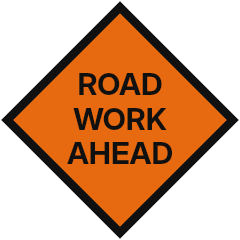
6. This sign is still standing late at night, and nobody is working. What should the driver assume?
Show answer
Answer B: The layout may still be altered, so the same care and reduced speed apply
Narrowed lanes, shifted alignments, dropped pavement edges and parked equipment remain overnight, so the hazard does not end when the crew goes home.
-
7. How does Arizona structure the administrative suspension of a first offender who tested at 0.08 or more?
Show answer
Answer D: At least 30 consecutive days with no driving, followed by at least 60 days of restricted driving
For a qualifying first offender Arizona suspends the driving privilege for at least 30 consecutive days and then restricts it for at least 60 further days rather than imposing a flat 90 day ban.
-
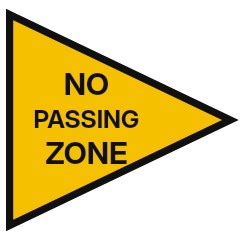
8. Where does the restriction that starts at this sign come to an end?
Show answer
Answer D: Where the centerline markings show that overtaking is allowed again
The sign marks the start of the restricted section, and the centerline markings along the road show how far it runs and where overtaking becomes lawful again.
-
9. You are circulating in a roundabout and a vehicle is waiting to enter ahead of you. What should you do?
Show answer
Answer D: Keep going, because circulating traffic does not stop for entering vehicles
Stopping in the circle to be polite surprises the drivers behind you and defeats the design; entering traffic is the side that waits.
-
10. The traffic signal is green, but the crossing lights on the tracks inside the intersection begin to flash. What must you do?
Show answer
Answer C: Stop clear of the tracks and wait, even though the signal is green
Active crossing warning devices outrank the green indication, so you stop short of the rails and wait until the warning stops.
-
11. Beside an accessible parking space there is an area painted with diagonal stripes. What is it for?
Show answer
Answer C: It is an access aisle for wheelchairs and lifts, and no vehicle may park or stop in it
The striped access aisle gives the room a ramp or lift needs to deploy, so blocking it makes the adjacent accessible space unusable.
-
12. You are the first driver on a road just after a storm. What should you plan for?
Show answer
Answer B: Branches, mud and other debris hidden around the next bend
Storm debris lands where nobody has cleared it yet, often just beyond a curve or a crest, so reduce speed and look much further ahead.
-
13. What civil penalty range applies to a second or subsequent violation of the Arizona hands-free law?
Show answer
Answer D: Between 150 and 250 dollars
Arizona raises the civil penalty for a second or subsequent hands-free violation to not less than 150 dollars and not more than 250 dollars.
-
14. What clearance must an Arizona driver leave when overtaking a bicycle?
Show answer
Answer A: At least three feet between the vehicle and the bicycle
Arizona requires a driver overtaking a bicycle to leave a safe distance of not less than three feet between the motor vehicle and the bicycle.
-
15. Which facility does this sign direct a traveler toward?

Show answer
Answer B: A hospital offering emergency care
This is the standard marker for medical care, used to lead a traveler to a hospital where emergency treatment is available.
-
16. The sign over the leftmost lane reads LEFT LANE MUST TURN LEFT. You are in that lane and want to go straight. What should you do?
Show answer
Answer C: Move out of the lane before the intersection if it is safe
A mandatory movement lane control sign makes the turn compulsory for that lane, so a driver who wants another movement must change lanes in advance.
-
17. What wireless device rule applies during the first 6 months of an Arizona Class G license?
Show answer
Answer C: A device may be used only in an emergency, or for audible turn-by-turn directions that need no manual entry while driving
For the first six months an Arizona Class G driver may not use a wireless communication device except in an emergency or for audible turn-by-turn guidance that requires no manual input while driving.
-
18. A lane is marked with a large white bicycle symbol and chevrons, but there is no separate bicycle lane. What does it mean?
Show answer
Answer A: Bicyclists may use the whole lane, so follow or pass with care
A shared lane marking shows that bicyclists and drivers use the same lane and positions riders away from parked car doors, so passing means changing lanes.
-
19. You are following a tractor-trailer so closely that its rear doors fill your windshield. What is the main problem?
Show answer
Answer D: You cannot see the road ahead and the truck driver cannot see you
A truck has a deep blind spot directly behind it, and tailgating also hides everything in front of the truck from you. Drop back so you can see and be seen.
-
20. Where does Arizona forbid a driver to park when fire apparatus has stopped to answer an alarm?
Show answer
Answer D: Within the block where the fire apparatus has stopped
Arizona bars parking within the block in which fire apparatus has stopped in answer to a fire alarm, and separately bars following such apparatus more closely than 500 feet.
-
21. Yellow signs each showing one large black arrowhead, installed in a row along the outside of a curve, are
Show answer
Answer D: chevron alignment signs marking the change of direction of the curve
Chevron alignment signs are placed on the outside of a curve so that several are in view at once, letting the driver judge how sharply the road turns.
-
22. A tow truck with flashing amber lights is loading a car on the shoulder ahead. How should you treat it?
Show answer
Answer B: Give it the same room as an emergency vehicle
Tow operators, utility crews and highway workers face the same danger from passing traffic, so move over or slow down for their flashing amber lights too.
-
23. Which color scheme is standard for the drums and barricades that channel traffic through a work zone?
Show answer
Answer C: Alternating orange and white retroreflective stripes
Drums and barricades carry alternating orange and white retroreflective stripes, and the traffic cones used in the same zones are predominantly orange.
-
24. On an Arizona two lane highway where passing is unsafe, when must a slow driver pull into the nearest turnout?
Show answer
Answer B: When five or more vehicles have formed in line behind the vehicle
Arizona requires a driver traveling below the normal speed of traffic on a two lane highway to turn off at the nearest designated turnout once five or more vehicles have formed behind.
-
25. At a four-way stop you and an opposing driver arrive together. You are going straight and the other driver is turning left across your path. Who goes first?
Show answer
Answer B: You do, because the left turn crosses your path
When two opposing drivers arrive together, the one going straight goes first and the left-turning driver yields.
-
26. How is the Arizona adult seat belt requirement enforced, and what does it cost?
Show answer
Answer A: It is enforced only as a secondary offense, and the civil penalty is capped at 10 dollars
Arizona treats the adult front seat belt rule as a secondary offense, so a stop needs another suspected violation, and it caps the civil penalty at 10 dollars.
-
27. Cannabis is legal for adults in some states. What does that mean for driving?
Show answer
Answer C: Driving while impaired by it is still an offense
Legal possession has nothing to do with driving law, and every state treats driving while impaired by cannabis as an offense.
-
28. You are traveling at 55 mph on a rural road and come up behind a horse-drawn buggy. What is the main danger?
Show answer
Answer D: You close on it very quickly because it moves at walking pace
A buggy travels only a few miles an hour, so the gap closes far faster than drivers expect and there is very little time to brake once you see it.
-
29. By how much may an Arizona certified funeral escort vehicle exceed the posted speed limit while managing a procession?
Show answer
Answer B: By up to 15 mph
Arizona allows a certified escort vehicle to exceed the posted speed limit by up to 15 mph while it is managing traffic for a procession.
-
30. Snow has covered the pavement markings on a two-lane road. How should a driver judge lane position?
Show answer
Answer B: By the tracks of other traffic and the roadside features
With the markings hidden, ruts left by earlier traffic, signs, poles and the line of the shoulder are the best clues to where the lane runs.