
Arizona MVD Permit Practice Test 4
- Questions30
- Correct to pass24
- Passing score80%
- Minimum age15 years 6 months
-
1. At a railroad crossing with no gates and no flashing lights, the crossbuck is normally combined with which sign?
Show answer
Answer C: A yield sign, or a stop sign where an engineering study calls for one
At a passive crossing the crossbuck forms an assembly with a yield sign, or with a stop sign when an engineering study or engineering judgment supports it, so the driver knows who must give way to the train.
-
2. A sign on a freeway restricts trucks to the two right-hand lanes. What should a car driver expect in those lanes?
Show answer
Answer A: More heavy vehicles and slower changes of speed
A truck lane restriction concentrates heavy vehicles on the right, and those vehicles accelerate, brake and change lanes far more slowly than cars.
-
3. You decide to turn around using a driveway on your right. What is the safer way to do it?
Show answer
Answer C: Stop past the driveway, reverse into it, then pull out and drive away
Passing the driveway and backing in means you reverse off the roadway and then rejoin traffic facing forward, with a full view of both directions.
-
4. May an Arizona driver pick up a phone while the vehicle is parked or stopped?
Show answer
Answer C: Yes, the prohibition applies to a vehicle being operated and not to one that is parked or stopped
The Arizona hands-free prohibition bites while a motor vehicle is being operated, so it does not restrict a driver whose vehicle is parked or stopped.
-
5. What is the basic rule for entering a roundabout?
Show answer
Answer B: Traffic already circulating goes first, and you wait for a gap
Entering traffic yields to vehicles already going around the circle, which is what keeps a roundabout moving instead of locking up.
-
6. In a normal signal cycle, what comes after a steady red indication?
Show answer
Answer A: A green indication that starts the next movement
Yellow is a warning that a movement is ending, so it never precedes a green; a red is followed by a green or a green arrow.
-
7. What is the safest way to leave a perpendicular parking space in a busy lot?
Show answer
Answer B: Back out slowly, checking both ways and yielding
Backing out gives you the poorest view of any maneuver, so it must be done slowly, with checks in both directions and with yielding to whoever is already there.
-
8. What civil penalty range applies to a second or subsequent violation of the Arizona hands-free law?
Show answer
Answer D: Between 150 and 250 dollars
Arizona raises the civil penalty for a second or subsequent hands-free violation to not less than 150 dollars and not more than 250 dollars.
-
9. Loose items slide around your car and rattle every time you brake. What is the answer?
Show answer
Answer C: Secure them before you start driving
Sliding objects pull your attention and can roll under the pedals, so stow them in the trunk or wedge them before the trip rather than chasing them during it.
-
10. How is the Arizona adult seat belt requirement enforced, and what does it cost?
Show answer
Answer A: It is enforced only as a secondary offense, and the civil penalty is capped at 10 dollars
Arizona treats the adult front seat belt rule as a secondary offense, so a stop needs another suspected violation, and it caps the civil penalty at 10 dollars.
-
11. Under Arizona law, what vehicle may the holder of a Class G driver license operate?
Show answer
Answer D: A single motor vehicle with a gross vehicle weight rating of 26,000 pounds or less
Arizona defines the Class G license as covering a single motor vehicle rated at 26,000 pounds or less, and it does not authorize a motorcycle unless a Class M endorsement is added.
-
12. Why is it worth planning your route before a long drive?
Show answer
Answer B: So that you are not reading a map or a screen while the car is moving
A driver who knows the route is not navigating at the wheel, which is one of the commonest sources of distraction.
-
13. A regulatory sign reads TURN ON HEADLIGHTS NEXT 15 MILES. What does it require?
Show answer
Answer C: Low beam headlights on for that stretch, day or night
Such a section is signed where a road is hard to see along, and the requirement is to run headlights, not just daytime running lamps, through the whole stretch even in bright daylight.
-
14. On a narrow residential street, why does parking tight against the curb matter so much?
Show answer
Answer C: Because fire trucks and ambulances need the width to get through
Cars parked even a foot out from the curb on both sides can narrow a street until a fire truck or ambulance cannot pass.
-
15. You are waiting to enter a two-lane roundabout and traffic is circulating in both lanes. What must you do?
Show answer
Answer A: Yield to traffic in both circulating lanes before you enter
Every entry to a roundabout is a yield point, and at a two-lane roundabout that means giving way to vehicles in either circulating lane.
-
16. Your light turns green, but a vehicle from the cross street is still finishing a turn inside the intersection. What should you do?
Show answer
Answer B: Wait until that vehicle has cleared the intersection
A green indication lets you proceed only after yielding to pedestrians in the crosswalk and to vehicles already lawfully within the intersection.
-
17. What speed rule applies to the ordinary vehicles taking part in an Arizona funeral procession?
Show answer
Answer C: They must observe the posted speed limits and take reasonable care to avoid a collision
Arizona gives the extra speed margin to the certified escort vehicle only, so the vehicles in the procession must keep to the posted limits and drive with reasonable and prudent care.
-
18. A sign on a long descent points to a RUNAWAY TRUCK RAMP a mile ahead. What is that ramp for?
Show answer
Answer C: Stopping a vehicle whose brakes have failed
An escape ramp climbs into deep gravel or sand to bring a vehicle with failed brakes to a halt, so no one should stop or park in it.
-
19. You are approaching a highway-rail grade crossing marked only with a crossbuck sign. What does that sign require?
Show answer
Answer A: Yield to any approaching train and cross only when the tracks are clear
The crossbuck is a regulatory yield sign, and a train can never stop or steer around a vehicle, so the driver must always give way.
-
20. Federal law lets a state open its high-occupancy vehicle lanes to certain vehicles carrying only one person. Which of these is covered by that allowance?
Show answer
Answer B: Motorcycles
Federal law lets states allow motorcycles into high-occupancy vehicle lanes regardless of the number of occupants, because keeping riders in the flow is safer than the alternative.
-
21. An Arizona instruction permit obtained at 15 years and 6 months of age is a permit for which license classes?
Show answer
Answer C: Class D or Class G
The Arizona instruction permit available from 15 years and 6 months is issued for a Class D or a Class G license, the two ordinary non-commercial classes.
-
22. You are on an entrance ramp merging onto a freeway. Who has to give way?
Show answer
Answer B: You must yield and fit into a gap in the traffic already on the freeway
Traffic entering a highway must yield to traffic already on it. Use the acceleration lane to match speed and merge into a gap.
-
23. You are turning right from a one-way street onto a two-way street. Where should the turn end?
Show answer
Answer A: In the lane nearest the right curb of the street you are entering
A right turn starts and finishes as close to the right as practical, so you leave the one-way street from the right lane and arrive in the lane nearest the right curb.
-
24. A yellow diamond showing a truck is posted beside a quarry entrance. What is it warning about?
Show answer
Answer A: Trucks turning onto the highway from that entrance
A truck crossing or trucks entering sign is used where heavy vehicles pull onto the road from a site, and they accelerate slowly once they are on it.
-
25. Below a speed limit sign is a smaller panel with white numbers on a black background and the word NIGHT. What does it show?
Show answer
Answer D: The limit that applies after dark
A night speed limit panel sets a separate legal maximum for the hours of darkness, and its reversed colors mark it as the night figure.
-
26. The light ahead is green but traffic beyond the intersection is backed up. What should you do?
Show answer
Answer B: Wait behind the intersection until there is room to clear it completely
You may not enter an intersection unless you can get completely through it, because stopping inside blocks cross traffic when the signal changes.
-
27. Which combination best reduces the chance of hydroplaning?
Show answer
Answer D: Good tread depth, correct tire pressure and lower speed in the rain
Tread channels water away, correct pressure keeps the tire's shape, and lower speed gives the tire time to push water aside. Hydroplaning can begin at surprisingly modest speeds.
-
28. You are the first to arrive at a crash on a rural road. What should you do first?
Show answer
Answer C: Park well clear of the scene, put on your hazard lights and call for help
Getting trained help on the way and keeping the scene visible does more good than anything an untrained bystander can do.
-
29. As a general rule, how far should you travel along a center two-way left-turn lane before you turn?
Show answer
Answer C: Only a short distance, just enough to slow down and wait for a gap
The center lane is for making or preparing a left turn, so you enter it only shortly before the turn and never travel along it as a through lane; several states set a specific limit such as 200 or 300 feet.
-
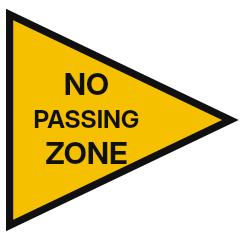
30. Where does the restriction that starts at this sign come to an end?
Show answer
Answer D: Where the centerline markings show that overtaking is allowed again
The sign marks the start of the restricted section, and the centerline markings along the road show how far it runs and where overtaking becomes lawful again.