
Arizona MVD Motorcycle Practice Test 26
- Questions30
- Correct to pass24
- Passing score80%
- Minimum age16 years
-
1. Partway through a ride, a control starts to feel different from the way it normally feels. What is the right response?
Show answer
Answer B: Stop somewhere safe and find out what has changed before riding further
A change in feel is usually the first warning of a failing cable, a leaking brake or a loose fastener, and it is far cheaper to check at the roadside than to discover in traffic.
-
2. Why should you avoid parking over tall dry grass or a pile of dead leaves?
Show answer
Answer B: Because the hot exhaust can set the dry material on fire
The exhaust system stays hot for a long time after a drive and can ignite dry vegetation underneath the vehicle.
-
3. How far back must an Arizona driver stay from emergency vehicles responding to a call?
Show answer
Answer C: At least 500 feet behind a fire department vehicle and at least 300 feet behind a police vehicle
Arizona sets two different following distances for responding emergency vehicles: 500 feet behind a fire department vehicle and 300 feet behind a police vehicle.
-
4. What should motorcycle footwear provide?
Show answer
Answer B: Sturdy support above the ankle with hard, slip resistant soles
Boots that cover the ankle support and protect it, while hard slip resistant soles keep the rider steady at stops, and laces should be tucked in so they cannot catch.
-
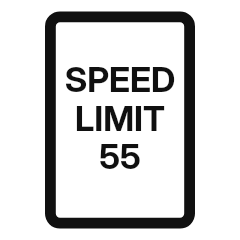
5. A driver passes this sign on an open road. Over what stretch does the figure it sets stay in force?
Show answer
Answer A: From the sign onward, in every lane, until another sign sets a different figure
The figure governs the road from the sign onward and binds every lane, and it stays in force until a later sign sets a different one.
-
6. Four vehicles reach a four-way stop from all four directions at the same instant. How is the deadlock resolved?
Show answer
Answer C: Each driver yields to the vehicle on the right and they go one by one
Yielding to the right applies to every driver, so the group untangles itself as drivers take turns rather than moving together.
-
7. From which lane should a permitted U-turn be started?
Show answer
Answer A: The lane nearest the center line, the same one used for a left turn
A U-turn is begun from the far left lane for your direction, the same position used for a left turn, so you do not cut across traffic beside you.
-
8. You reach an intersection with no signs, signals or markings clearly before a vehicle that is approaching on your right. What is the rule?
Show answer
Answer B: You may go first because you got there first
At an uncontrolled intersection the first driver to arrive goes first; the yield to the right rule only settles a tie.
-
9. May you park at the curb immediately next to a railroad crossing?
Show answer
Answer A: No, you must leave the crossing and its approach clear
Parking beside a crossing hides the tracks and the signals from approaching drivers and leaves no room for a vehicle that has to clear the rails.
-
10. Why must a rider pay attention to the turn signal after completing a turn or lane change?
Show answer
Answer A: Many motorcycle signals do not cancel themselves and can mislead other drivers
A signal left flashing tells other drivers the rider is about to turn again, and a driver may pull out in front of the motorcycle because of it.
-
11. You are waiting in a left-turn lane at a green light when a fire engine with lights and siren comes toward you in the oncoming lanes. What should you do?
Show answer
Answer D: Hold your position and let the fire engine pass
Turning across the path of an approaching emergency vehicle is exactly what you must not do; stay put until it has gone by.
-
12. Where should a touring rider keep the rain suit?
Show answer
Answer B: Somewhere it can be reached quickly without unpacking everything
Rain gear only helps if you can get to it before you are soaked, so pack it where a quick roadside stop is enough to reach it.
-
13. When should you move into the lane you need for a turn?
Show answer
Answer D: Well before the intersection, as soon as you know your route
Getting into the correct lane early lets other drivers read your intentions and keeps you from making a sudden lane change at the corner.
-
14. Which restrictions apply to an Arizona motorcycle instruction permit holder?
Show answer
Answer A: No passengers, no freeway or interstate riding, and no riding between sunset and sunrise or when visibility is under 500 feet
An Arizona motorcycle permit holder may not carry passengers, may not ride on freeways or interstate highways, and may not ride between sunset and sunrise or whenever there is not enough light to see people or vehicles at 500 feet.
-
15. What is the main advantage of a face shield over goggles?
Show answer
Answer D: It protects the whole face, not only the eyes
Goggles keep wind and debris out of the eyes, but a shatter resistant face shield also protects the rest of the face in a crash.
-
16. A yellow diamond showing two vertical arrows, one pointing up and one pointing down, warns that
Show answer
Answer A: the road ahead carries traffic in both directions
The two-way traffic sign warns that the roadway ahead is not divided and that vehicles will be coming from the opposite direction.
-
17. A blue motorist service sign showing a fuel symbol and an arrow means that
Show answer
Answer D: fuel is available in the direction shown, and the sign imposes no obligation
Service signs are informational: they tell the driver what is available and in which direction, but they create no requirement.
-
18. In most states, when are headlights required apart from times of poor visibility?
Show answer
Answer A: From about half an hour after sunset to half an hour before sunrise
Most states require lights from about half an hour after sunset until about half an hour before sunrise, and some simply say sunset to sunrise; lights are also required whenever visibility is poor.
-
19. How do stimulant drugs such as amphetamines or cocaine typically affect driving?
Show answer
Answer D: They can make the driver overconfident and more willing to take risks
Stimulants create a false sense of alertness and encourage aggressive, risky driving. When they wear off, sudden fatigue can follow.
-
20. Traffic is entering the freeway from a ramp ahead of you and you are in the right lane. What should you do?
Show answer
Answer C: Move to another lane if it is safe, or adjust your speed to make room
Merging drivers may have little room to adjust. Helping them in by changing lanes or easing your speed prevents conflicts even though they must legally yield to you.
-
21. What does the choke, or enrichener, do on a motorcycle that has one?
Show answer
Answer B: It gives the engine a richer fuel mixture so a cold engine will start
A cold engine needs more fuel in proportion to air, and the choke supplies that richer mixture until the engine warms up.
-
22. You are driving along a street lined with parked cars. What should you watch for?
Show answer
Answer B: Doors opening, vehicles pulling out and pedestrians stepping from between cars
Parked cars hide people and can move without warning. Keep as much space from them as you safely can and cover the brake.
-
23. What must an Arizona driver do at a school crossing where the portable signs are in place and a person is in the crosswalk?
Show answer
Answer D: Come to a complete stop at the school crossing
Where the portable school signs are properly maintained, Arizona requires every vehicle to come to a complete stop at the school crossing whenever the crosswalk is occupied by a person.
-
24. How should a long trip be broken up to keep the driver alert?
Show answer
Answer D: Stop for a break every couple of hours and share out the driving
Regular breaks and a change of driver are the only reliable answers to fatigue; caffeine only postpones it.
-
25. How should a passenger swing their leg when getting off the motorcycle?
Show answer
Answer D: High and clear of the exhaust and the rear of the machine
A leg dragged low across the back of the motorcycle can catch the seat or the luggage and will find the hot exhaust, so it is lifted well clear.
-
26. A yellow diamond shows a car with wavy lines behind its rear tires. What is the warning?
Show answer
Answer D: The surface loses grip badly when it is wet
The slippery when wet sign marks a stretch where traction falls off sharply in rain, so speed and braking must be reduced well in advance.
-
27. Why should a rider pull in the clutch at the first sign that the engine is seizing?
Show answer
Answer B: So a locking engine cannot lock the rear wheel through the drive train
A seizing engine can lock up, and with the clutch engaged that would lock the rear wheel, so disconnecting the drive keeps the wheel rolling while you coast off the road.
-
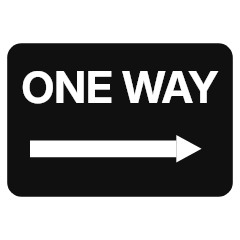
28. A driver disregards this sign and turns so as to travel against the direction it establishes. What is the immediate danger?
Show answer
Answer D: The driver will face traffic head on, because every lane comes the other way
Turning against the established direction puts the vehicle nose to nose with all the traffic on that street, which is why the mistake has to be corrected at once.
-
29. A steady downward green arrow is displayed over a lane. What does it indicate?
Show answer
Answer C: The lane is open to traffic in your direction
A steady downward green arrow means the lane it points to is open to traffic traveling in your direction.
-
30. What should you expect while driving through a parking lot?
Show answer
Answer D: Pedestrians and vehicles moving from any direction, so drive slowly
Parking lots mix walking people, reversing vehicles and poor sight lines, so low speed and constant scanning are the only reliable protection.