
Arizona MVD Motorcycle Practice Test 5
- Questions30
- Correct to pass24
- Passing score80%
- Minimum age16 years
-
1. Some toll facilities use signs and markings with a purple background or a purple stripe. What do they identify?
Show answer
Answer D: Lanes reserved for vehicles with an electronic toll account
Purple is assigned to lanes and ramps restricted to vehicles with a registered electronic toll collection account, so drivers without one must stay out.
-
2. A yellow curve warning sign carries a yellow plaque showing a speed. What does that number mean?
Show answer
Answer D: The recommended maximum safe speed for the curve under ideal conditions
An advisory speed plaque on a yellow warning sign gives the recommended maximum speed for the hazard ahead when conditions are good.
-
3. What should a rider remember about convex mirrors?
Show answer
Answer B: They show a wider view, but vehicles look farther away and slower than they are
The curved glass fits more of the scene into the mirror, and the price of that extra width is a distorted sense of distance and closing speed.
-
4. When should a passenger get on the motorcycle?
Show answer
Answer D: After the engine has been started and the operator is ready
Mounting after the engine is running and the operator is settled keeps the motorcycle stable and spares the operator a long balancing act with the extra weight aboard.
-
5. The queue for an exit ramp has backed up into the right lane of the highway. What should you do if you want that exit?
Show answer
Answer B: Join the back of the queue in the lane instead of cutting in later
Passing a queue and forcing in at the front stops the whole line, and using the shoulder puts you where broken-down vehicles are expected to be.
-
6. What does a NARROW BRIDGE warning sign tell a driver?
Show answer
Answer A: The bridge is tighter than the road leading up to it
A narrow bridge still carries both directions, but with much less clearance than the approaches, so drivers should slow and hold their lane position carefully.
-
7. You face a red light at an intersection that has no stop line and no marked crosswalk. Where must you stop?
Show answer
Answer C: Before entering the intersection
With no line and no crosswalk, the stopping point is the near edge of the intersecting roadway, close enough to see cross traffic but clear of it.
-
8. You spot a deep pothole that the riders behind you will not be able to see until it is too late. What is the usual way to warn them?
Show answer
Answer B: Point at it with a hand or a foot on the side it lies on
Pointing at the hazard on the correct side tells the riders behind both that something is there and where in the lane it is.
-
9. Why do experienced riders cover the clutch lever and the brake lever in heavy traffic?
Show answer
Answer B: It shortens the time needed to react if they suddenly have to stop
With fingers already resting on the levers the rider skips the time it takes to reach for them, which shortens overall stopping distance.
-
10. About how much alcohol can the body eliminate per hour?
Show answer
Answer A: About one standard drink
The liver removes alcohol at a nearly fixed rate of roughly one standard drink per hour. Drinking faster than that raises the blood alcohol level, and nothing speeds the process.
-
11. Another driver takes a right of way that was legally yours. What should you do?
Show answer
Answer A: Give way to the other driver and avoid the crash, whatever the law says
Right of way is something you give, not something you take, and being in the right is no protection in a collision.
-
12. What makes up the total distance needed to bring a vehicle to a stop?
Show answer
Answer A: The distance covered while you perceive the hazard, the distance covered while you react, and the braking distance
Total stopping distance combines the ground covered while you notice the hazard, the ground covered while you move your foot to the brake, and the ground covered while the brakes slow the vehicle.
-
13. You are riding directly into a low sun that is glaring off your face shield. What should you do?
Show answer
Answer A: Slow down and assume that drivers ahead of you cannot see you either
Glare cuts what everyone can see, so lower speed buys reaction time, and a driver blinded by the same sun is even less likely to notice a motorcycle.
-
14. Why is being predictable an important part of driving safely?
Show answer
Answer A: Because other road users are able to plan around what you are doing
Other drivers make their decisions from what they expect you to do, so surprises are what produce collisions.
-
15. Why should a rider avoid painting a helmet or cleaning it with strong solvents?
Show answer
Answer D: Chemicals can weaken the shell and the liner without showing it
Solvents and some paints attack the shell and the foam, so use mild soap and water and follow the maker's instructions to keep the helmet's protection intact.
-
16. Why should riding clothing have no loose flapping parts?
Show answer
Answer B: Loose cloth can catch on the machine, and flapping tires the rider
Loose fabric can snag on the controls, the chain or a wheel, and the constant flapping and noise wear the rider out over a long ride.
-
17. Rain is falling and the outside temperature reads close to 32 degrees Fahrenheit. Why is that dangerous?
Show answer
Answer A: The rain can freeze on contact and glaze the road with ice
Near freezing, rain landing on cold pavement can turn to a glaze of ice almost at once, so a road that looks merely wet may have no grip at all.
-
18. A regulatory message is normally carried on a sign whose shape is
Show answer
Answer A: a rectangle standing taller than it is wide
Regulatory signs that state a law, such as speed limits and turn restrictions, use a vertical rectangle with a black legend on a white background.
-
19. What is the friction zone of the clutch?
Show answer
Answer A: The range of lever travel where power starts to reach the rear wheel
Easing the clutch lever into the friction zone lets the engine drive the rear wheel gradually, which is what makes a smooth start from a stop possible.
-
20. A black on white regulatory sign at an intersection reads NO TURNS. What may a driver do there?
Show answer
Answer B: Only continue straight through the intersection
The NO TURNS sign bans turns in every direction at that intersection, so the only lawful movement from that approach is straight through.
-
21. What does Arizona law say about wireless devices behind the wheel?
Show answer
Answer B: Holding or supporting a wireless device while driving is prohibited, but hands-free and voice-to-text use is allowed
Arizona bans holding or supporting a wireless device while driving, along with reading or writing text-based communication and watching, recording or broadcasting video, while permitting hands-free and voice-to-text operation.
-
22. You are leaving a freeway on an exit ramp posted with an advisory speed of 25 mph. Where should you slow to that speed?
Show answer
Answer A: In the deceleration lane, before you reach the curve of the ramp
Slowing belongs in the deceleration lane so you arrive at the curve already at the advisory speed and do not hold up traffic still in the through lanes.
-
23. This sign comes into view ahead of a driver who has already started along a ramp. What should the driver do?
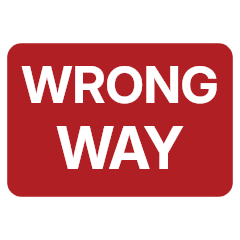
Show answer
Answer B: Pull clear where it is safe, then turn around and leave the ramp traveling properly
The driver is traveling against the legal flow, so the safest response is to stop clear of the lanes, turn the vehicle around and get off the ramp before meeting traffic head on.
-
24. You are backing out of a space in a parking lot. Who has the right of way?
Show answer
Answer D: Traffic already moving in the lane, and pedestrians walking behind you
A driver backing out must yield to vehicles and pedestrians already using the lane, because backing is the movement with the poorest view.
-
25. You find that the road surface has turned to sheet ice. What speed is appropriate?
Show answer
Answer A: A crawl, slow enough that you could stop without braking hard
Ice can cut grip to a fraction of normal, so stopping takes many times the usual distance and only a crawl leaves any margin.
-
26. What is true about the oily strip down the center of a traffic lane?
Show answer
Answer D: It usually gives enough traction, but heavy buildups where vehicles idle should be avoided
Passing tires keep the central strip largely clear, but the thick deposits that collect at busy intersections and toll booths really are slick.
-
27. You are already inside a roundabout when an emergency vehicle approaches with lights and siren. What should you do?
Show answer
Answer B: Continue to your exit, leave the roundabout, then pull over and stop
Stopping inside a roundabout blocks the circulating roadway, so you should exit first and then pull over clear of the intersection.
-
28. You approach an intersection where the signal is flashing yellow. What should you do?
Show answer
Answer D: Slow down and cross the intersection with caution
A flashing yellow signal warns you to slow down and cross with care; it does not require a stop, but it does not give you priority either.
-
29. Why are sign shapes and colors standardized across the whole country?
Show answer
Answer D: So a driver knows the kind of message before reading it
Uniform shapes and colors let a driver classify a sign as regulatory, warning or guide from a distance, before the legend can be read.
-
30. Below a speed limit sign is a smaller panel with white numbers on a black background and the word NIGHT. What does it show?
Show answer
Answer D: The limit that applies after dark
A night speed limit panel sets a separate legal maximum for the hours of darkness, and its reversed colors mark it as the night figure.