
Arizona MVD Motorcycle Practice Test 46
- Questions30
- Correct to pass24
- Passing score80%
- Minimum age16 years
-
1. Two vehicles meet on a steep, narrow mountain road with no room to pass. Which driver should back up?
Show answer
Answer C: The driver heading downhill, who has more control while reversing
On a narrow mountain road the vehicle facing downhill yields, because backing uphill gives better control than reversing down a grade.
-
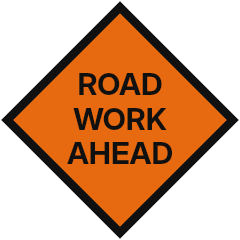
2. How should speed and following distance be adjusted beyond this sign?
Show answer
Answer D: Cut speed and leave a longer gap, because traffic can stop without warning
Traffic in these areas stops and starts unexpectedly and there is little room to steer around a problem, so extra space is what prevents a rear-end collision.
-
3. How should following distance change when you ride at night?
Show answer
Answer D: Open it up to three seconds or more
Less light means hazards appear later, so a rider should slow down and stretch the following distance to three seconds or more.
-
4. A driver stopped on suspicion of impaired driving refuses to take a chemical test. What happens?
Show answer
Answer D: A license penalty follows for the refusal itself
Under implied consent, holding a license means agreeing to testing, so a refusal brings its own suspension separately from anything the court decides.
-
5. You are riding on a multi-lane road with a car traveling beside you in the lane on your right. Which lane position is usually best?
Show answer
Answer D: The left portion, so you keep a cushion of space from the car alongside
Lane position is chosen to hold space between the motorcycle and the nearest hazard, and here that hazard is the vehicle on the right.
-
6. A bicyclist stops at a four-way stop just before you do. Who goes first?
Show answer
Answer B: The bicyclist, who reached the intersection and stopped there before you did
A bicyclist on the roadway follows the same right of way rules as a driver, so arrival order decides the turn.
-
7. What should a rider do if the front wheel locks during braking?
Show answer
Answer A: Release the front brake immediately, then reapply it firmly
A locked front wheel cannot steer or hold the motorcycle up, so the brake must be released to let the wheel roll again and then reapplied smoothly.
-
8. What are painted curb markings mainly used for?
Show answer
Answer D: Conveying parking and stopping regulations
Colored curbs tell drivers where waiting or parking is restricted, and because the exact color meanings are set locally a driver should also read the posted signs.
-
9. An arrow panel in a work zone shows four flashing lamps in caution mode instead of an arrow. What does that display mean?
Show answer
Answer A: Warning only, so pass the work area with caution in your current lane
Caution mode gives a general warning without directing a lane change, so drivers stay alert and pass the activity with care.
-
10. A clutch cable adjusted with no free play at all causes what problem?
Show answer
Answer B: The clutch may slip and never fully engage
Without a small amount of slack the release mechanism keeps a light load on the plates, so they slip instead of transmitting full power.
-
11. An overhead sign shows that the right lane is EXIT ONLY. What does that mean if you intend to stay on the highway?
Show answer
Answer B: You have to move out of that lane before the exit
An exit only lane leaves the highway completely, so a driver continuing on the highway has to change lanes before it does.
-
12. You have stopped on the shoulder of a highway and want to rejoin the traffic. What is the correct way?
Show answer
Answer D: Signal, build up speed along the shoulder, then merge into a gap
Entering a fast lane at a slow speed is what causes the conflict, so the shoulder is used to gain speed before the merge in the same way as an acceleration lane.
-
13. At a four-way stop another driver pulls out ahead of you when it was clearly your turn. What is the correct response?
Show answer
Answer B: Let that driver go through, then take your turn when the way is clear again
Right of way is something you give, never something you take, so yielding to a driver who takes it wrongly avoids a crash you would otherwise share.
-
14. At night you are waiting to turn left and can see only the headlights of an approaching vehicle. Why should you allow a bigger margin?
Show answer
Answer D: Because lights alone make speed and distance hard to judge
With no other visual cues, two points of light give you very little information about how fast the vehicle is closing, so leave extra margin.
-
15. A city transit bus ahead of you has stopped at the curb with its passenger door open. What does the law require of you?
Show answer
Answer D: Nothing special, but pass slowly and watch for people
The mandatory stop applies to a school bus showing red flashing lights, not to a transit bus, though a careful driver still slows for crossing passengers.
-
16. Why is passing another vehicle a bad idea in dense fog?
Show answer
Answer C: You cannot see far enough ahead to know the passing lane is clear
A pass needs a clear view of the road well beyond the vehicle you are overtaking, and fog takes exactly that away.
-
17. Why do safety agencies put head protection first among riding gear?
Show answer
Answer A: Because head injuries are the leading cause of death in motorcycle crashes
Head injury is the most common cause of death in motorcycle crashes, which is why a certified helmet is the single most important piece of gear.
-
18. How should a rider take curves while carrying a passenger?
Show answer
Answer A: More slowly than when riding alone
The extra weight raises the center of gravity and makes the motorcycle respond more slowly, so curves have to be taken at a lower speed.
-
19. What is the purpose of carrying a first aid kit in your vehicle?
Show answer
Answer D: It lets you treat cuts and bleeding while the help is on its way
A kit is for simple first aid such as controlling bleeding until trained help arrives, not a substitute for calling for that help.
-
20. Why do experienced riders squeeze the clutch lever while starting the engine, even with the neutral light showing?
Show answer
Answer A: In case a gear is engaged, so the motorcycle cannot lurch forward
A neutral light can be wrong, and a disengaged clutch means the machine stays still even if the transmission is actually in gear.
-
21. Which of these does NOT affect how fast alcohol reaches the bloodstream?
Show answer
Answer A: How confident the drinker feels
Food, the strength of the drinks and the speed of drinking all change how fast alcohol is absorbed, but a drinker's confidence changes nothing at all.
-
22. You are stopped at a stop sign waiting to turn onto a highway where traffic moves at 55 mph. How should you choose your gap?
Show answer
Answer A: Wait for a much larger gap than the one you would accept on a city street
Fast traffic covers ground while you are still accelerating, so the gap that feels adequate at 25 mph is dangerously short at highway speed.
-
23. How does becoming chilled affect a rider before any shivering is obvious?
Show answer
Answer D: It slows reactions and clouds judgment while the rider still feels fine
Cooling degrades reaction time and decision making before the rider notices it, so dress for the coldest part of the ride and stop to warm up rather than pressing on.
-
24. About how far ahead do low beam headlights let you see on a dark road?
Show answer
Answer B: About 250 feet
Low beams light roughly 250 feet of road, and high beams roughly 350 to 500 feet, which sets the limit on a safe night speed.
-
25. You are about to pass a slower vehicle on a two lane road. What should you do with the gears?
Show answer
Answer B: Downshift before you begin, so the engine can accelerate strongly
A lower gear puts the engine in the part of its range where it accelerates best, which shortens the time spent in the oncoming lane.
-
26. You have a green light at a school crossing, but the crossing guard steps out and holds up a stop sign toward you. What must you do?
Show answer
Answer A: Stop, because the crossing guard controls this crossing and outranks the signal
Directions from a crossing guard or a police officer take priority over signals and signs.
-
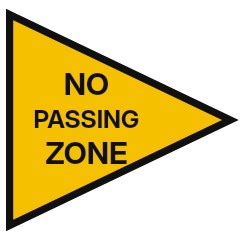
27. Why would a restriction like this one be applied to a stretch of road?
Show answer
Answer A: Because there is not enough visible road ahead to complete a pass safely
Limits on overtaking are set where a hill, a curve or an obstruction leaves too little sight distance for a driver to pull out, pass and return before meeting oncoming traffic.
-
28. On a typical motorcycle, which of these controls does the rider operate with the right hand?
Show answer
Answer C: The front brake lever
The front brake lever sits on the right handlebar and is squeezed with the right hand, while the clutch lever is on the left handlebar.
-
29. Your group reaches a work zone where the lane has been narrowed by cones and the surface is uneven. What should the formation do?
Show answer
Answer B: Move to single file and give each rider the whole width of the lane
A narrowed or broken surface leaves no spare room inside the lane, so riders need the full lane width each and must drop into single file.
-
30. A yellow sign reading DEAD END is posted at the entrance to a street. What does it mean?
Show answer
Answer D: The street ends and there is no way through
A dead end street stops at its far end, so a driver who enters must come back out the same way.