
Arizona MVD Motorcycle Practice Test 39
- Questions30
- Correct to pass24
- Passing score80%
- Minimum age16 years
-
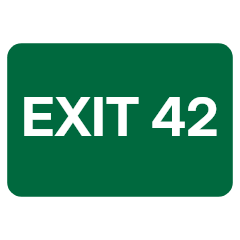
1. A driver in the left lane of a freeway realizes only when level with this sign that the ramp beside it is the one they need. What is the correct action?
Show answer
Answer A: Carry on to the next interchange and turn back from there
There is no safe way back to a ramp once it has been reached from the wrong lane, so the driver keeps going to the next interchange, where the ramps are built for that movement.
-
2. A ball rolls into the street from between parked cars ahead of you. What should you expect and do?
Show answer
Answer A: Expect a child to follow it and be ready to stop
A ball is usually followed by a child who is watching the ball and not the traffic. Slow down and be prepared to stop immediately.
-
3. Your passenger wants to carry a bag in one hand during the ride. What should you tell them?
Show answer
Answer B: No, both hands are needed to hold on, so the bag must be secured on the machine
A passenger needs both hands on the operator or the handholds, and anything carried loose can be dropped into the wheel or pull the passenger off balance.
-
4. You are passing a tractor-trailer on a wet freeway and its wheels throw heavy spray. What is the best technique?
Show answer
Answer B: Increase your wipers and pass steadily without hesitating
Spray blinds you for as long as you stay beside the truck, so prepare the wipers first and then spend as little time in the spray as possible.
-
5. Why must the handlebars be kept square during a hard straight line stop?
Show answer
Answer B: Because a front wheel turned under heavy braking can put the machine down
With the front tire loaded to its limit, any steering input asks it to do two jobs at once and the front end can wash out instantly.
-
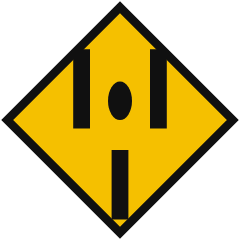
6. What must a driver be ready for beyond this sign?
Show answer
Answer C: Vehicles approaching from the opposite direction in the next lane over
The separation between the two directions runs out, so from that point oncoming vehicles share the same pavement and the driver has to keep right.
-
7. Federal law lets a state open its high-occupancy vehicle lanes to certain vehicles carrying only one person. Which of these is covered by that allowance?
Show answer
Answer B: Motorcycles
Federal law lets states allow motorcycles into high-occupancy vehicle lanes regardless of the number of occupants, because keeping riders in the flow is safer than the alternative.
-
8. When is a wet road usually most slippery?
Show answer
Answer C: Just after the rain starts, before the surface oil is washed away
Oil and dirt lying on the pavement mix with the first water and cut traction badly until continued rain washes the residue to the side of the road.
-
9. Why is smooth, early braking better than hard, late braking?
Show answer
Answer D: It keeps you in control and gives the driver behind more warning
Braking early and gently keeps the tires well within their grip and gives following drivers time to react to your brake lights.
-
10. You are riding a shaded back road in autumn and reach a mat of wet leaves covering the pavement. What should you expect?
Show answer
Answer D: Traction can be nearly as poor as ice, so slow down before you reach them
Wet leaves are slick and they hide whatever is underneath, so reduce speed before the patch and cross it upright without braking or turning.
-
11. What does a yield sign require of a driver?
Show answer
Answer A: Slow down, and stop when necessary, so conflicting traffic can go first
A yield sign obliges the driver to reduce to a speed suited to conditions and to stop when needed so that conflicting traffic or pedestrians are not interfered with.
-
12. What do flashing yellow lights on a school bus mean?
Show answer
Answer A: The bus is about to stop to load or unload, so prepare to stop
The amber lights are the warning phase that comes before the red lights and the stop arm, so drivers should slow down and get ready to stop.
-
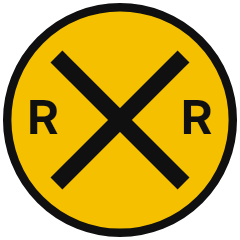
13. Where is this sign installed in relation to the hazard it announces?
Show answer
Answer A: Far enough before the hazard that a driver can slow down and stop short of it
This is an advance warning sign, placed on the approach so a driver has time to react before reaching a crossing that a curve or a crest may be hiding.
-
14. Two left-turn lanes are available and you must turn right again a short distance after the turn. Which of the two should you use?
Show answer
Answer D: The right one, so you finish nearer the right side of the new street
Each turn lane feeds the matching lane of the new street, so choosing the right-hand of the two left-turn lanes leaves you closer to the side you will need.
-
15. You reach a stretch of road covered by moving flood water of unknown depth. What is the correct decision?
Show answer
Answer D: Turn around and take another route
About a foot of moving water is enough to carry away most cars, and the roadbed under the water may already be washed out, so the only safe choice is to turn around.
-
16. On a busy multilane highway, where is the best place to travel?
Show answer
Answer B: In a gap in the traffic, with space open on both sides
Travelling in a gap keeps escape routes open on both sides, while riding alongside other vehicles removes the room you would need to swerve.
-
17. You are fitting a tank bag to your motorcycle. What must you check?
Show answer
Answer B: That it does not foul the handlebars or block your view of the instruments
A bag that catches the bars at full lock or hides the instruments interferes with control of the motorcycle exactly where the rider needs it most.
-
18. What happens when alcohol is combined with another drug that also affects the nervous system?
Show answer
Answer B: Impairment is often far greater than either one alone would produce
Combined substances can multiply each other's effects, producing impairment well beyond what a driver would expect from either one taken separately.
-
19. What do the numbers on a pedestrian countdown display show?
Show answer
Answer A: The seconds remaining to finish a crossing already under way
The countdown runs during the pedestrian change interval and shows how many seconds are left before the crossing time ends.
-
20. Apart from giving you room to stop, what else does a longer following gap do for you?
Show answer
Answer D: It widens your view of the road and the traffic ahead
Sitting further back lets you see past and around the vehicle in front, so hazards reach your eyes seconds earlier.
-
21. Does the Arizona hands-free law apply to the navigation system built into the dashboard of a vehicle?
Show answer
Answer B: No, a navigation or global positioning system built into the vehicle is outside the prohibition
The Arizona statute exempts navigation and global positioning systems built into the vehicle, along with hands-free in-vehicle communication systems, from the hands-free prohibition.
-
22. You pass into a work zone with a reduced speed limit but you see no workers. What speed applies?
Show answer
Answer D: The posted work zone limit, whether or not workers are present
A posted work zone speed limit is a regulatory limit in force at all times, and narrow lanes and uneven surfaces remain dangerous when nobody is working.
-
23. You are following closely behind a vehicle you intend to pass on a two-lane road. What should you do first?
Show answer
Answer D: Drop back to give yourself room to build speed before you pull out
From close behind you cannot see far enough ahead and you have no room to gather speed, so the pass takes longer and starts blind.
-
24. What should the clutch be doing during a quick stop?
Show answer
Answer C: Pulled in as the motorcycle slows, so the engine does not stall
Disengaging the clutch as the machine slows keeps the engine running, so the rider can pull away again immediately if that becomes necessary.
-
25. You are joining a highway from a short ramp that has no acceleration lane. What should you do?
Show answer
Answer A: Stop or slow at the end of the ramp and wait for a safe gap
Without an acceleration lane there is no room to match speed, so you must yield at the end of the ramp and enter only when a gap allows it.
-
26. The street you are turning right onto has a bike lane along its right edge. Where should your vehicle end up?
Show answer
Answer B: In the first traffic lane to the left of the bike lane
A bike lane is not a travel lane for motor vehicles, so the nearest lane you may finish a right turn in is the first general traffic lane beside it.
-
27. You are driving on the through road of a T-intersection and want to turn left into the side road. Oncoming traffic is approaching on the through road. What must you do?
Show answer
Answer C: Yield to the oncoming traffic before you turn
The vehicle waiting in the stem of the T yields to both of you, but you still owe the right of way to oncoming through traffic before turning across it.
-
28. Blue pavement markings are used together with white markings at
Show answer
Answer D: parking spaces reserved for people with disabilities
Blue supplements the white markings of accessible parking spaces, which is the only assignment blue has on the pavement.
-
29. You are entering a marked school zone during the posted hours. What should you do?
Show answer
Answer A: Slow to the school zone limit and watch for children
The school zone limit applies throughout the posted hours, whether or not you can see any children at that moment.
-
30. The traffic signal is green, but the crossing lights on the tracks inside the intersection begin to flash. What must you do?
Show answer
Answer C: Stop clear of the tracks and wait, even though the signal is green
Active crossing warning devices outrank the green indication, so you stop short of the rails and wait until the warning stops.