
Arizona MVD Motorcycle Practice Test 32
- Questions30
- Correct to pass24
- Passing score80%
- Minimum age16 years
-
1. Why must a tank bag be strapped down properly rather than simply laid on the tank?
Show answer
Answer D: Because a bag that slides can reach the controls or your hands
Braking pushes anything loose on the tank forward toward the handlebars, where it can jam the steering or interfere with the levers.
-
2. A steady green downward arrow is displayed above the lane you are in. What does it tell you?
Show answer
Answer A: You may drive in that lane
A green downward arrow means the lane beneath it is open for travel in your direction.
-
3. You are about to pass a bicyclist on a narrow two-lane road. What is the correct way to do it?
Show answer
Answer A: Wait for a clear gap and move well left, giving the rider wide space
Pass a cyclist as you would a car: wait for clear road, change lane position to leave generous clearance, and return only when the rider is well behind you.
-
4. Why is hard braking the wrong response to a tire blowout at speed?
Show answer
Answer C: Because it can pull the vehicle further out of line and start it spinning
With one tire gone the braking forces are uneven, so heavy braking increases the pull to one side and can spin the vehicle.
-
5. You are approaching a traffic light that has been green for a long time. How should you treat it?
Show answer
Answer C: Expect it to change and be ready to stop
A light that has been green for a while is called a stale green light. Cover the brake and decide in advance where you could still stop safely.
-
6. What does the thick foam liner inside a certified helmet actually do in a crash?
Show answer
Answer C: It crushes so the head slows down over a longer time and distance
The crushable liner is the part that absorbs energy, letting the head decelerate gradually instead of stopping instantly against a hard surface.
-
7. You approach a traffic signal that has already been green since it first came into view. What should you expect?
Show answer
Answer B: That it may change at any moment, so be ready to stop
A signal already green when you first see it is well into its cycle, so a rider covers the brakes and plans a stop rather than assuming a clear run.
-
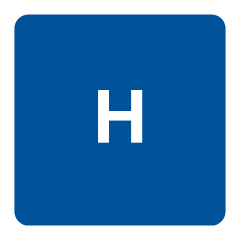
8. Which of these is announced with the same family of signs as the facility shown here?
Show answer
Answer A: A rest area for travelers
A rest area belongs to the same motorist service series, which points travelers toward facilities such as fuel, food, lodging and medical care.
-
9. The vehicle you have borrowed is larger and heavier than your own. How should you drive it?
Show answer
Answer B: Allow more room for stopping and for turns until you are used to it
Extra weight and length mean longer stopping distances and wider turns, so give yourself more room until you are used to it.
-
10. If you must abandon a vehicle stuck on the tracks with a train coming, why do you move toward the train and away at an angle?
Show answer
Answer D: Because debris from the impact is thrown forward, away from the train
A train pushes wreckage down the track ahead of it, so walking toward the train and off to the side keeps you out of the debris path.
-
11. Which item does most to keep a rider comfortable in cold weather beyond a jacket and gloves?
Show answer
Answer B: A close fitting neck cover that stops air entering at the collar
Cold air funnelled in at the neck chills the whole body, so a snug neck tube or balaclava makes a large difference, while a loose scarf is a hazard because it can catch.
-
12. You stop behind another vehicle at a traffic light. How much space should you leave?
Show answer
Answer D: Enough to see where its rear tires touch the pavement
Seeing the rear tires on the road leaves room to steer around the vehicle if it stalls, and gives a cushion if you are struck from behind.
-
13. What matters most about the armor built into a riding jacket?
Show answer
Answer B: That it sits over the joints and stays there during a fall
Armor only works where it is, so the jacket must fit closely enough that the pads stay over the shoulders, elbows and spine when the rider hits the ground.
-
14. How often should you check your mirrors while driving?
Show answer
Answer C: Every few seconds, so you always know what is around you
Traffic behind and beside you changes constantly. Frequent, brief mirror checks keep a picture of your surroundings current so nothing surprises you.
-
15. Does wearing properly fitted earplugs stop a rider from hearing important sounds?
Show answer
Answer C: No, they lower overall noise while horns and speech still register
Earplugs reduce the wind roar that masks everything else, so riders wearing them often hear traffic more clearly, not less, while their hearing is protected.
-
16. A yield sign is posted where an entrance ramp meets the highway. What must you do?
Show answer
Answer C: Give way to the traffic already on the highway and merge into a gap
The yield sign confirms that the merging driver is the one who must fit into the traffic stream rather than the other way round.
-
17. What is the best way to handle fatigue on a long ride?
Show answer
Answer C: Take rest breaks regularly and dress to keep wind and cold out
Wind, vibration and cold tire a rider faster than a driver, and the safe answer is planned breaks and protective clothing rather than pressing on.
-
18. Why is standing water across a road dangerous even when it looks shallow?
Show answer
Answer B: It can hide a washed out roadbed, a deep hole or a missing cover
You cannot see the surface under the water, and floods commonly wash the roadbed away or lift covers off drains.
-
19. Where should you be looking as you steer through a turn?
Show answer
Answer C: Toward the point on the new road where you want to end up
Drivers steer toward what they look at, so looking through the turn to where you want to go keeps the path smooth and accurate.
-
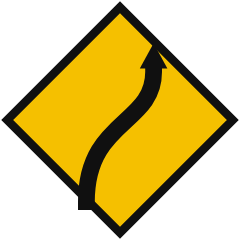
20. A driver holds a steady highway speed into the section this sign warns about. What is the most likely result?
Show answer
Answer B: The vehicle runs wide toward the outside and can cross into another lane or leave the pavement
Holding speed into a change of alignment asks the tires for more side grip than they can supply, so the vehicle runs wide and the driver is left with less room to correct.
-
21. Your navigation device tells you to turn where a road sign says the turn is closed. What should you do?
Show answer
Answer B: Follow the signs and what you can see
A device works from stored data that can be out of date, while signs and the road in front of you show the situation now, so the road wins every time.
-
22. Which sign tells you that the vehicles ahead are part of a funeral procession?
Show answer
Answer C: Headlights burning in daylight, with small flags or markers on the vehicles
Processions are normally identified by daytime headlights, hazard lights and flags or windshield markers, not by emergency lights or sirens.
-
23. A squirrel darts into your path a short distance ahead. What is normally the safest response?
Show answer
Answer C: Hold your line, brake as much as is safe, and accept hitting a small animal
Swerving without space, or crashing while braking, hurts the rider far more than a small animal does, so stay in your lane and slow as much as traction allows.
-
24. Where is ice most likely to form first on a cold day?
Show answer
Answer B: In shaded areas and on bridges and overpasses
Shaded spots stay cold longer and bridges and overpasses lose heat from below as well as above, so ice appears there before it appears elsewhere.
-
25. Under the Arizona speed statute, exceeding which speed in a location other than a school crossing or a business or residential district is prima facie evidence of an unreasonable speed?
Show answer
Answer B: 65 mph
The Arizona statute names three prima facie limits, and 65 mph is the one that applies in locations that are neither school crossings nor business or residential districts.
-
26. Where is a road work ahead sign placed?
Show answer
Answer B: In advance of the work space or detour, so drivers are warned before reaching it
Advance warning signs are placed upstream of the work space or detour so that drivers have time to slow down and change lanes before reaching the activity.
-
27. The low sun is directly ahead and glare makes it hard to see. What should you do?
Show answer
Answer C: Slow down, use the sun visor or sunglasses, and increase following distance
Sun glare can hide pedestrians, brake lights and signals. Reducing speed and adding space gives you time to react to what you cannot yet see.
-
28. You are calling 911 to report a crash. Which information matters most?
Show answer
Answer C: The exact location, how many people are hurt and any hazard such as fire
Dispatchers need to know where to send help, how much help to send, and what dangers the crews will meet on arrival.
-
29. How is the yield sign shaped and colored?
Show answer
Answer C: A downward-pointing triangle with a wide red border and a red legend on white
The yield sign is a downward-pointing equilateral triangle with a wide red border and the legend in red on a white background, an outline used for no other message.
-
30. Which of these would appear as a symbol on a blue general service sign?
Show answer
Answer A: A hospital
General service signs cover facilities such as hospitals, fuel, food, lodging, camping, telephones and rest areas, all shown in white on blue.