
Arizona MVD Permit Practice Test 36
- Questions30
- Correct to pass24
- Passing score80%
- Minimum age15 years 6 months
-
1. A vehicle ahead of you displays a reflective orange triangle on its rear. What does that emblem tell you?
Show answer
Answer B: The vehicle is built to travel at 25 mph or less
The orange triangle is the slow moving vehicle emblem used on farm and construction equipment designed for 25 mph or less, warning you that you are closing on it much faster than it appears.
-
2. How should a pregnant driver or passenger wear a seat belt?
Show answer
Answer A: Lap belt below the belly across the hips, shoulder belt across the chest
A properly worn belt protects both mother and baby. The lap portion goes low under the belly, snug across the hip bones, and the shoulder belt crosses between the breasts.
-
3. What alcohol concentration can cost an Arizona driver under 21 the driving privilege?
Show answer
Answer D: Any alcohol concentration at all
Arizona applies a zero tolerance rule to drivers under 21, whose license may be suspended if there is any alcohol concentration.
-
4. Why are motorcycles so often missed by other drivers?
Show answer
Answer C: Their narrow shape is easily hidden in traffic
A motorcycle presents a narrow outline that disappears behind pillars, mirrors and other vehicles, and it is harder to judge its speed and distance.
-
5. On an Arizona two lane highway where passing is unsafe, when must a slow driver pull into the nearest turnout?
Show answer
Answer B: When five or more vehicles have formed in line behind the vehicle
Arizona requires a driver traveling below the normal speed of traffic on a two lane highway to turn off at the nearest designated turnout once five or more vehicles have formed behind.
-
6. Why is dusk one of the harder times of day to drive?
Show answer
Answer B: The failing light blurs shapes into the background
In fading light there is not enough contrast to pick objects out, yet it is not dark enough for headlights to do the work, so pedestrians and cyclists disappear.
-
7. What is the rule about leaving a child or a pet in a parked vehicle?
Show answer
Answer A: Never do it; the inside can turn deadly hot very quickly
The inside of a parked vehicle heats far faster than the air outside, and cracking a window does not prevent it, so a child or animal must never be left there.
-
8. How should your speed behave while you move from one lane into the next?
Show answer
Answer C: Keep it steady or adjust it smoothly to match the traffic in the new lane
A lane change works best as a smooth movement at the speed of the lane you are joining, since sudden braking or acceleration surprises the drivers around you.
-
9. A driver is following you far too closely. What is the best response?
Show answer
Answer D: Increase your own following distance and let the driver pass when it is safe
More room ahead of you means you can slow gradually instead of braking hard, which reduces the chance of being struck from behind, and letting the driver by removes the problem entirely.
-
10. What is the correct technique for backing a vehicle straight?
Show answer
Answer B: Check behind the vehicle before getting in, then turn and look through the rear window while backing slowly
Mirrors and cameras leave gaps close to the vehicle, so walk behind it first, then turn in your seat for a direct view and keep the speed low enough to stop instantly.
-
11. You have started to pass and you see the no-passing zone beginning ahead. What should you do?
Show answer
Answer D: Ease off, drop back and return to your own lane
A pass must be completed before the no-passing zone starts. If it will not fit, abandon it and slot back in behind.
-
12. How should you handle a prescription or over the counter medicine before driving?
Show answer
Answer D: Read the label and ask a pharmacist or doctor whether it affects driving
Many common medicines, including allergy and cold remedies, cause drowsiness or slowed reactions, and the label or a pharmacist can tell you whether driving is safe.
-
13. Smoke and flames appear from the engine compartment after you stop. What should you do?
Show answer
Answer A: Get everyone well away from the vehicle first, and then call the fire service
A vehicle fire can spread within seconds, so people come out first and firefighting is left to the fire service.
-
14. For an alert driver, about how long is the reaction time once a hazard has been recognized?
Show answer
Answer A: About three quarters of a second
Reaction alone takes roughly three quarters of a second for an alert driver, and perception takes about as long again, so a second and a half of travel is added before the brakes bite.
-
15. How does Arizona punish a first conviction for racing or an exhibition of speed on a highway?
Show answer
Answer A: A class 1 misdemeanor with a minimum fine of 250 dollars
Arizona makes a first racing or exhibition of speed offense a class 1 misdemeanor with a minimum fine of 250 dollars, and the court may suspend the driving privilege for up to 90 days.
-
16. May you park in front of a public or private driveway?
Show answer
Answer A: No, blocking a driveway is prohibited even for a short time
Parking in front of a driveway blocks the property owner from entering or leaving, and the prohibition does not depend on how long you stay.
-
17. You make eye contact with a driver waiting to pull out of a side street. What should you assume?
Show answer
Answer D: The driver may still not have seen you, so stay ready to slow or stop
Drivers can look directly at you and still not register your vehicle, especially a small one. Eye contact helps, but never rely on it.
-
18. How should a turn at an intersection be taken on a wet road?
Show answer
Answer C: Slow earlier than usual and steer smoothly through the corner
Wet pavement leaves less grip, so the speed must come off before the turn and the steering must be gentle enough not to break traction.
-
19. A train has just cleared a crossing that carries two sets of tracks. What should you do?
Show answer
Answer B: Wait and look both ways for a second train
A passing train hides a second train on the other track, so wait until the signals stop and you can see that both tracks are clear.
-
20. You are in the open lane where another lane is merging into yours. What is your part in the merge?
Show answer
Answer A: Keep a steady speed and leave a gap for one vehicle to come in
A merge works when each driver in the through lane lets one vehicle in, which keeps both lines moving instead of stopping them both.
-
21. What counts as a complete stop at a stop sign?
Show answer
Answer C: The wheels stop turning before the stop line
A legal stop means the vehicle is no longer moving, made at the stop line or before entering the crosswalk or intersection.
-
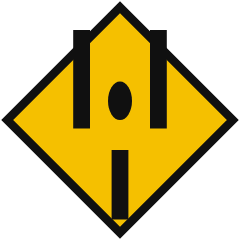
22. What change in the road does this sign announce?
Show answer
Answer B: The two directions of travel are about to be separated, and the driver must keep to the right of the separation
Ahead the roadway splits into separate one-way roadways on either side of a median, so the driver stays to the right of the divider and no longer meets oncoming vehicles.
-
23. An oncoming driver flashes their headlights while you are waiting to turn left. What should you do?
Show answer
Answer D: Judge the situation yourself, since the flash may mean something else
A flash is not a legal signal and may mean many things, so the decision to turn stays yours and must be based on what you can see.
-
24. Visibility drops suddenly and you decide to leave the highway. What is the safest way to do it?
Show answer
Answer A: Take the next exit or a wide pull off, well clear of the traffic lanes
Get right off the traveled way, and off the shoulder too if you can, because vehicles in poor visibility often drift onto the shoulder.
-
25. What is the first thing to do once your disabled vehicle is stopped on the shoulder?
Show answer
Answer A: Switch on the hazard warning lights so other drivers can see the vehicle
Hazard lights are the fastest way to make a stopped vehicle visible, and everything else can follow once traffic has been warned.
-
26. A piece of farm machinery ahead of you is wider than its own lane. What should you do?
Show answer
Answer C: Hold back until you can see far enough to pass safely
Wide equipment leaves no gap inside the lane and may use part of the other side, so a pass needs a long clear view of the road ahead.
-
27. You are circulating in a roundabout and a vehicle is waiting to enter ahead of you. What should you do?
Show answer
Answer D: Keep going, because circulating traffic does not stop for entering vehicles
Stopping in the circle to be polite surprises the drivers behind you and defeats the design; entering traffic is the side that waits.
-
28. Besides school signing, which warning signs may also use a fluorescent yellow-green background?
Show answer
Answer C: Pedestrian and bicycle warning signs
Pedestrian crossing, bicycle and playground warning signs may use either the standard yellow or the fluorescent yellow-green background, which draws extra attention where people outside vehicles are present.
-
29. The route marker used for an Interstate highway is a shield with
Show answer
Answer A: white numerals on a blue field under a red band carrying the word INTERSTATE
The Interstate route marker is a cutout shield with a white border, the word INTERSTATE in white on red across the top and the route number in white on blue.
-
30. A large truck ahead of you in a roundabout is using part of both lanes as it goes around. What is the correct response?
Show answer
Answer B: Stay back and give it room until it leaves the roundabout
Long vehicles need extra width to get around the central island, so drivers behind must hold back rather than share the space beside them.