
Arizona MVD Permit Practice Test 27
- Questions30
- Correct to pass24
- Passing score80%
- Minimum age15 years 6 months
-
1. Along a highway the reference markers count upward as you travel. Where does the numbering normally begin?
Show answer
Answer C: At the southern or western edge of the state
Mileage numbering starts where the route enters the state from the south or the west, so rising numbers tell a driver which way they are heading.
-
2. You have fitted small convex blind spot mirrors to the door mirrors. What is true of them?
Show answer
Answer A: They help a good deal, but you should still look over your shoulder as well
Add-on mirrors reduce but do not remove the blind spot, and they make vehicles look smaller and further away.
-
3. You are approaching a sharp curve. When should you reduce your speed?
Show answer
Answer D: Before you enter the curve, so you can accelerate gently through it
Braking hard inside a curve uses up the traction that is already being demanded for cornering, so the slowing must be finished before you enter.
-
4. You are backing a trailer and want its rear to move to the left. Which way should you turn the steering wheel?
Show answer
Answer A: Move the bottom of the wheel to the left, which turns the top to the right
A trailer moves opposite to the tow vehicle's steering when backing. Holding the wheel at the bottom and moving your hand in the direction you want the trailer to go makes this easier.
-
5. You are approaching a yield sign and no other vehicle is anywhere in sight. What does the sign require?
Show answer
Answer A: Slow down and be ready to stop, but stop only if needed
A yield sign requires you to slow and give way, and to stop only when traffic or pedestrians make stopping necessary.
-
6. You are about to make a three-point turn on a narrow two-way street. What is the first step?
Show answer
Answer B: Pull close to the right edge, signal left and check traffic both ways
A three-point turn starts from a stop at the right edge with a left signal, and you only move once you have checked that both directions are clear.
-
7. School warning signs use which background and legend colors?
Show answer
Answer A: A black legend and border on a fluorescent yellow-green background
School warning signs carry a black legend and border on a fluorescent yellow-green background, a shade chosen so they stand out from ordinary yellow warning signs.
-
8. What should you avoid when a hostile driver pulls alongside you?
Show answer
Answer A: Making eye contact, or answering the gestures in any way at all
Any response, including a look, encourages an aggressive driver, so give none and let the vehicle go.
-
9. A stop sign at a busy corner has a stop line and a crosswalk, but buildings block your view of the cross street. What is the correct sequence?
Show answer
Answer C: Stop at the line first, then edge forward and stop again to see
The first stop is required at the line or before the crosswalk, and a second stop farther forward is what actually lets you yield safely.
-
10. A person using a wheelchair is waiting to cross at a corner ahead. How should you treat that person?
Show answer
Answer B: As a pedestrian with the right of way at the crossing
A wheelchair or a mobility scooter user has the rights of a pedestrian, so yield the whole crossing and wait until the crossing is finished.
-
11. Your navigation device tells you to turn where a road sign says the turn is closed. What should you do?
Show answer
Answer B: Follow the signs and what you can see
A device works from stored data that can be out of date, while signs and the road in front of you show the situation now, so the road wins every time.
-
12. You receive a phone call that you feel you must answer while driving. What is the safest way to take it?
Show answer
Answer D: Pull off the road, stop in a safe place and then answer
No call is worth a crash. Stopping in a safe location removes the distraction completely, while every other option divides your attention.
-
13. What alcohol concentration defines Extreme DUI in Arizona?
Show answer
Answer B: 0.15 or higher
Arizona defines Extreme DUI at 0.15 or higher, with a first offense minimum of 30 consecutive days in jail, and imposes even harsher minimums at 0.20 or higher.
-
14. How does Arizona classify a first conviction for reckless driving, and what may happen to the license?
Show answer
Answer A: A class 2 misdemeanor, and the driving privilege may be suspended for up to 90 days
Arizona treats a first reckless driving offense as a class 2 misdemeanor and allows the driving privilege to be suspended for a period of up to 90 days.
-
15. How long does a parallel parking space need to be for the car you are driving?
Show answer
Answer D: About five or six feet longer than your vehicle
A few extra feet at each end give you the room to swing in and to straighten up without touching the vehicles in front or behind.
-
16. Why is being predictable an important part of driving safely?
Show answer
Answer A: Because other road users are able to plan around what you are doing
Other drivers make their decisions from what they expect you to do, so surprises are what produce collisions.
-
17. A driver leaves the vehicle at the curb where this sign is posted and walks away for two minutes. Is that allowed?
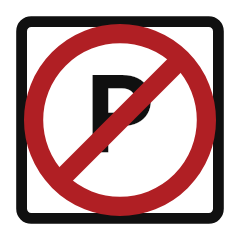
Show answer
Answer B: No, leaving the vehicle unattended there is prohibited whatever the length of the absence
Walking away leaves the vehicle parked, and the prohibition holds regardless of how long the driver is gone or whether the engine is left running.
-
18. Why is it risky to brake hard and steer sharply at the same moment?
Show answer
Answer C: The tires have a limited amount of grip that braking and turning must share
Each tire can deliver only so much grip, and asking it to slow the vehicle and change direction at once can exceed that limit and start a skid.
-
19. Your wiper blades smear the windshield instead of clearing it. What should you do?
Show answer
Answer C: Replace the blades, because smearing means that the rubber is worn
Worn or hardened rubber cannot wipe cleanly, and blades are cheap compared with driving without a clear view.
-
20. You are making a legal U-turn at an intersection. Who has the right of way?
Show answer
Answer C: Everyone else, until your turn is complete
A U-turn crosses several paths at once, so you yield to oncoming vehicles, to crossing traffic and to pedestrians before starting it.
-
21. A crash happens directly in front of you and vehicles are blocking both lanes. What should you do?
Show answer
Answer B: Stop at a safe distance, put on the hazards and warn the traffic behind
The greatest danger after a crash is a second collision, so stop short of it and make sure the traffic behind you can see the problem.
-
22. Besides its height, what else matters about a head restraint?
Show answer
Answer C: That it is close to the back of the head, and not far behind it
A restraint that sits far behind the head lets the head snap back before it is caught, so a small gap is important.
-
23. You arrive at an intersection where the traffic signals are completely dark after a power failure. What should you do?
Show answer
Answer A: Treat the intersection as an all-way stop and take turns
When a signal is dark or out of order, drivers on every approach must stop and proceed in turn, exactly as at a four-way stop.
-
24. Reaching for a drink in the cup holder is which kind of distraction?
Show answer
Answer A: Manual and visual at the same time
Your hand leaves the wheel and your eyes flick down to find the cup, so a task that feels trivial takes away two of the three things driving needs.
-
25. You are turning left out of a driveway onto a busy two-way street. What must you do?
Show answer
Answer D: Wait for a gap in both directions before you start to move
The turn crosses one direction of traffic and joins the other, so you need a gap in both before leaving the driveway rather than stopping across a lane.
-
26. A curb sign reads No Standing. What does it allow you to do?
Show answer
Answer B: Stop only long enough to pick up or drop off passengers
No Standing bars waiting for any purpose except the brief moment needed to let passengers in or out, which is stricter than No Parking.
-
27. Why should the shoulder belt never be worn under the arm or behind the back?
Show answer
Answer C: In a crash it could not hold your upper body and could cause severe injury
The shoulder belt restrains your chest and head. Placed under the arm it concentrates crash force on the ribs and organs; behind the back it does nothing at all.
-
28. How should the outside mirrors be aimed to reduce your blind spots?
Show answer
Answer A: Outward, so each one covers the lane beside you rather than repeating the inside mirror
Mirrors aimed too far inward show you the same road three times and leave a large gap beside the vehicle, so aiming them outward shrinks the blind spot.
-
29. You are driving at night on an unlit road using low beams. How should you choose your speed?
Show answer
Answer C: So you could stop within the distance your headlights light up
Driving faster than you can stop within the lit area is called overdriving your headlights. Anything beyond the beam is invisible until it is too late to react.
-
30. A white regulatory sign shows the silhouette of a truck inside a red circle with a diagonal slash. What does it mean?
Show answer
Answer A: Trucks are not allowed to use that road
The circle and slash over a symbol always means the movement or vehicle shown is prohibited, so trucks must keep off that roadway.